AI in action with Team CX (US)
Author:Jag Seth
Published:Sep 27, 2026

As AI becomes part of the operating layer at Zip, it is changing more than how quickly work gets done. In Customer Experience (CX), it is reshaping how teams find context, understand customer needs and decide where human attention can have the greatest impact.
Jag Seth, VP of Customer Experience US, shares how AI is becoming embedded across the customer experience workflow - and why the opportunity is not simply to handle more interactions, but to create more space for judgment, empathy and higher-value customer conversations.
From Manual Work to an Intelligent Workflow
Customer Experience has always required teams to process enormous amounts of information. Previously, agents searched knowledge sources for answers, while teams manually reviewed conversations and looked for patterns across thousands of interactions. Even creating Help Center content or troubleshooting a workflow meant working through product documentation, logs or code. AI is changing that operating model.
For customers, Zia, our customer-facing AI support agent, helps resolve inquiries through automated servicing before human-agent intervention is required, enabling self-service and surfacing answers instantly. For agents, AI helps identify customer intent, locate relevant knowledge, summarize interactions, and draft contextual responses, allowing agents to work more efficiently and focus on more complex customer needs. Across the wider organization, Zipsters use AI to analyze conversations at scale, uncover contact drivers, maintain knowledge, troubleshoot workflows, and improve forecasting.
The important shift is not simply that these tasks happen faster. AI is increasingly the first step in how our CX team approaches a problem—reducing the time spent finding information and increasing the time available to decide what it means.
Changing What the Team Can Take On
As one Zipster on our team put it, “AI has not changed what the team is capable of. It has changed what the team can actually get to - and how quickly it can get there.”
Work that might once have been deprioritized because of the effort involved can now move forward. In one example, a Zipster used AI to identify conflicting messages within Zia that were contributing to poor Customer Satisfaction (CSAT) scores overnight - an issue difficult to uncover through manual analysis alone. In another, AI mapped contact drivers across CBTs, the categories used to understand why customers are contacting support, in minutes rather than through a labor-intensive review.
Zipsters have also used AI as a thought partner to evolve the CX metrics model. Clearer thresholds for when to monitor an issue and when to mobilize help the team put fluctuations in CSAT into context and focus on the largest opportunities. These examples reveal the bigger change: AI is not simply compressing individual tasks. In the hands of capable, curious employees, it is expanding what a CX organization can realistically accomplish.
Making More Room for What Humans Do Best
The purpose of saving time is not simply to give people time back. It is to redirect their capacity toward work that can create more value: investigating root causes, improving customer journeys, coaching colleagues, resolving complex issues and turning insight into action.
Human judgment remains fundamental because customer experience often happens in the gray areas. A frustrated customer may have already tried several times to resolve an issue. Someone worried about their finances may need to feel understood before they are ready to hear an answer. Policy may point one way while the wider context warrants a closer look.
AI can surface information, identify patterns and suggest a response. It cannot remove the need for empathy, experience or accountability.
As I like to think, “AI can increasingly provide the context. Our humans still own the accountability.”
The strongest CX employees will not simply accept AI-generated answers. They will frame problems, ask better questions, evaluate outputs and apply their understanding of the customer and the business.
AI is not removing people from customer experience. It is helping ensure they spend their time where being human creates the most value: complexity, ambiguity, escalation, relationship repair and judgment.
From Reactive to Preventative CX
The next opportunity is to move further upstream.
Traditional customer service often begins after friction has occurred: a customer encounters a problem, reaches out and the CX team responds. AI creates an opportunity to recognize signals sooner - understanding where customers are struggling, who may be affected and which patterns are emerging.
Routine needs can increasingly be handled through intelligent self-service, while human interactions focus where they genuinely add value. Over time, CX can become more than the function that handles customer contacts. It can operate as an intelligence layer for the company, identifying friction, connecting customer insight back to Product and Operations, and helping address why customers need support in the first place.
That is the bigger shift taking place at Zip. AI is helping the team see more, understand more and act sooner. Human judgment determines what happens next.
Help Us Build What’s Next
At Zip, AI is becoming part of how our teams solve problems, make decisions and create better experiences for customers.
We are building a workplace for people who are curious about what AI makes possible - and who know how to turn that capability into meaningful human outcomes.
If that sounds like the kind of work you want to be part of, explore our current US opportunities and see where you can help change the game.
Like what you've read?
Check out these other articles

Oct 15, 2026
Life at Zip
UnZipped: Healthy Cities Challenge
Author: Multiple Contributors
Three AU-based Zipsters reflect on memorable moments from the 2026 BUPA Healthy Cities Challenge.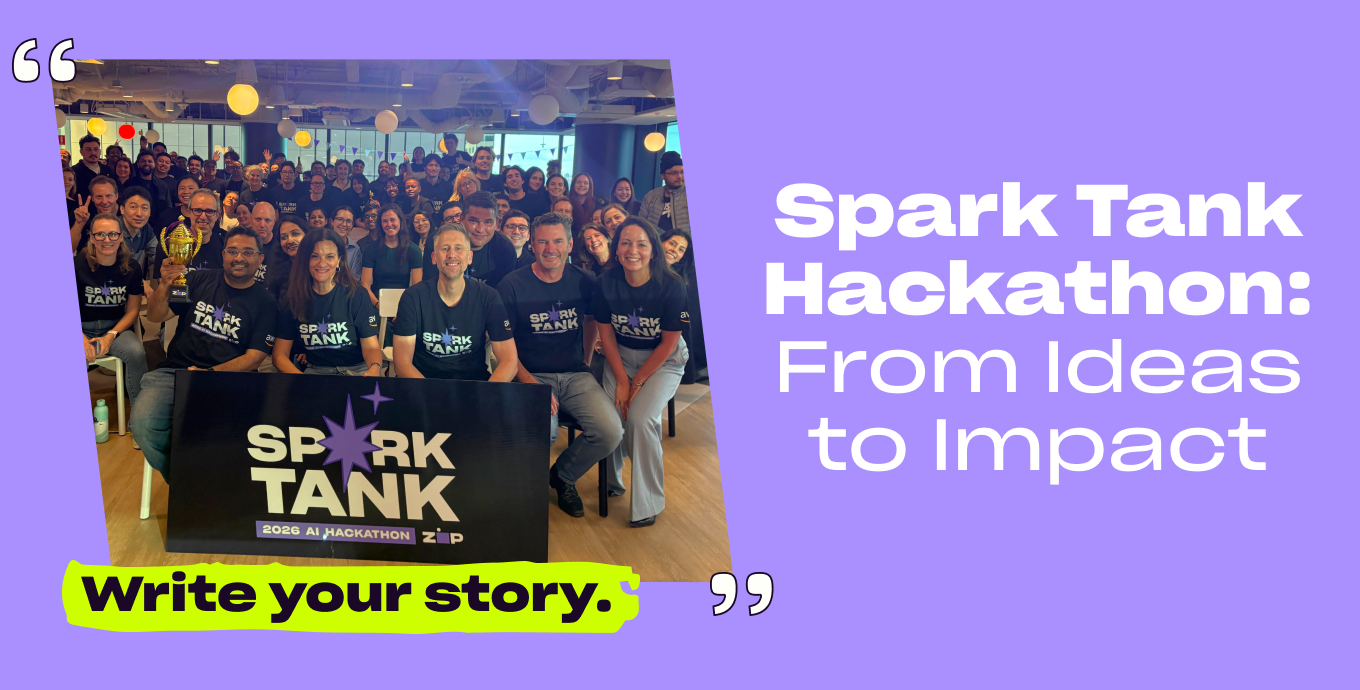
Oct 14, 2026
Life at Zip
Spark Tank Hackathon: From Ideas to Impact
Author: Multiple Contributors
Three Zipsters from across our AU business reflect on Spark Tank, our recent AI-themed Hackathon and Learning Experience.
Sep 08, 2026
Life at Zip
From Australia to the US: Inside Zip’s first ZipDip
Author: Marina Harpur
Meet Marina Harpur, who recently completed our first ZipDip program placement in New York. Read on to learn more about her experience.


