From Australia to the US: Inside Zip’s first ZipDip
Author:Marina Harpur
Published:Sep 08, 2026

What could you learn by stepping out of your day-to-day role and immersing yourself in a completely different part of the business?
That’s the idea behind ZipDip, our careers placement experience designed to give Zipsters the opportunity to spend time embedded in another team or market, build new connections and bring fresh perspectives back to their home team.
For our first ZipDip, Director, Credit Risk Marina Harpur swapped Australia for the US, spending three weeks getting under the hood of our US business. From New York to Washington DC, she joined leadership conversations, spent time with teams across the business, shared lessons from Australia and experienced firsthand how another Zip business operates.
Here’s what she learned along the way…
Different market, same Zip
If you want to know how a city is evolving, talk to your driver.
During my first week in New York, I was lucky enough to get an Uber driver who had been driving around the city for 30 years. He told me there are far fewer yellow cabs on the streets today, with many drivers flocking to Uber and Lyft in pursuit of a more streamlined operation. His KPIs these days? In his words, essentially: “avoid traffic and avoid tickets”. He was clearly hitting them at 100%.
It was an unexpectedly fitting introduction to my first week with Zip US. Different product, different market, different customer segments - but still the same company, united by our goal to think Customer First.
And just like at home, there are familiar challenges around prioritisation, scale and diversification.
What felt different was the intensity. There’s an acute awareness of the competition in the US and a real desire to move at pace. The opportunities can be significant, but the moments to capture them can come and go quickly too.
That sense of urgency was something I felt throughout my ZipDip.
Getting under the hood
One of the things I wanted to understand was how the US teams decide where to focus their energy.
Zip US has cross-functional teams aligned to different parts of the customer lifecycle, bringing together the capabilities needed to solve customer problems and deliver outcomes.
In my book, the cross-functional approach always wins when it comes to the speed and quality of delivery. But it also creates a familiar challenge: how do you make the right prioritisation decisions and trade-offs when there are lots of good things you could be doing?
The US team has been developing a quantitative approach to evaluating product initiatives, considering things like business and customer impact, confidence, effort and strategic value. Before an initiative can be properly evaluated, teams need to be clear on some deceptively simple questions:
- What problem are we solving?
- What’s our proposed approach?
- What impact do we expect?
- Who will it affect and at what scale?
- And roughly how complex will it be to deliver?
There’s also a healthy dose of AI helping along the way. Claude is in full adoption in the US, helping teams take detailed problem and solution documents, test whether there’s enough information, structure assumptions and risks, and support the evaluation process.
What impressed me wasn’t merely the framework itself. It was the discipline of making the problem, customer impact and expected business value clear before teams invest time solving it.
Learning goes both ways
By week two, I’d also picked up a few Americanisms.
“There’s a lot of wood to chop here” became a favourite quote, along with talking something through “before starting cooking”.
I tried that one on a fellow Aussie. He didn’t flinch, so I took it as a good sign. Beyond expanding my vocabulary, I had the opportunity to spend time with people from right across the US business.
I joined leadership meetings, had follow-up conversations with individual leaders and shared my observations back with the Australian team. There is a lot we can learn from how the US operates, while still embracing the nuances that make each of our markets different. I also spent time with the Commercial team, learning about merchant segmentation, US sales cycles and what successful partnerships look like.
One thing I hadn’t fully appreciated until I arrived was how some of our partnerships are increasingly becoming global. Teams across Zip are working closely together and finding opportunities to take advantage of our collective scale.
That became one of my biggest reflections from the experience: ZipDip isn’t about taking one market’s playbook and dropping it into another. It’s about seeing what can travel. It’s understanding what another team does brilliantly, sharing what works in your own market, and working out where those ideas can make both businesses stronger.
The core is cool
For my final week, I travelled to Washington DC and had the privilege of joining the US QBR (Quarterly Business Review).
Zip US is a predominantly remote business, so these moments are an important opportunity for leaders to come together, review business performance, discuss what’s being delivered and talk through areas of contention.
Different perspectives were shared openly, but in a very collegial way, with a clear focus on what actions needed to follow.
Again, what struck me was the speed and sense of urgency. The US team is acutely aware of emerging opportunities and the competition around them. These moments can be fleeting, but if you lock them in, they can set the business up for years to come.
We talked about new products, capital management, longer-term strategy and future distribution opportunities. But one comment really stayed with me:
‘The core is cool.’ It’s easy for all of us to be attracted to the emerging opportunities and the next new thing. But keeping the engine humming is an incredibly important job.
I also got my own opportunity to contribute, with a timeslot to talk about the Australian operating environment, our business and North Star, and to share some of the success stories and technology we’ve rolled out in Australia.
That was an important part of ZipDip for me. I wasn’t there just to observe the US business. I could share some of what we’ve learned in Australia too.
What I’m bringing home
After three weeks, I came away with pages of notes, plenty of new connections and more than a few ideas to bring back to Australia.
But three reflections stand out:
- Move with urgency, but prioritise deliberately. There will always be more opportunities than there is capacity. Moving quickly matters, but being clear on the customer problem, business impact and strategic value helps make sure that energy goes to the right places.
- Share what works, without assuming one size fits all. Australia and the US are different markets with different customers, products and operating environments. That’s exactly what makes the exchange valuable. We can learn from each other without needing to become identical.
- Keep the engine humming. It might be tempting to focus on the shiny new opportunity, but looking after the core is what gives you the foundation to pursue the next one.
Most of all, I came away with an even greater appreciation of what becomes possible when we create opportunities for Zipsters to get out of their usual lanes and immerse themselves somewhere new.
ZipDip gave me access to people I wouldn’t ordinarily work alongside every day. I got to see another market from the inside, contribute my own perspective and build relationships that will continue well beyond these three weeks.
For me, that’s what ZipDip is all about: immersing yourself somewhere new, seeing your own business through a different lens, and coming back with a broader view of what’s possible.
Like what you've read?
Check out these other articles

Oct 15, 2026
Life at Zip
UnZipped: Healthy Cities Challenge
Author: Multiple Contributors
Three AU-based Zipsters reflect on memorable moments from the 2026 BUPA Healthy Cities Challenge.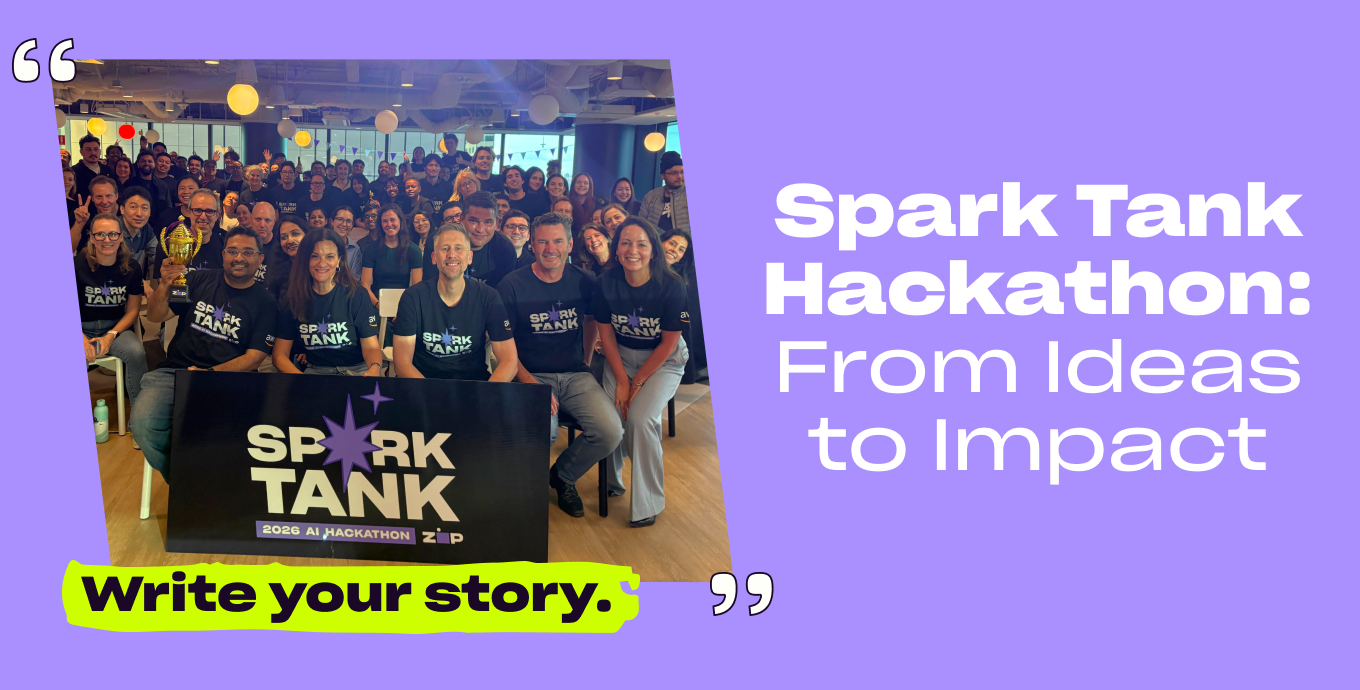
Oct 14, 2026
Life at Zip
Spark Tank Hackathon: From Ideas to Impact
Author: Multiple Contributors
Three Zipsters from across our AU business reflect on Spark Tank, our recent AI-themed Hackathon and Learning Experience.
Sep 27, 2026
Technology
AI in action with Team CX (US)
Author: Jag Seth
Hear from US VP Customer Experience Jag Seth on how AI is re-shaping how our teams service customers.


